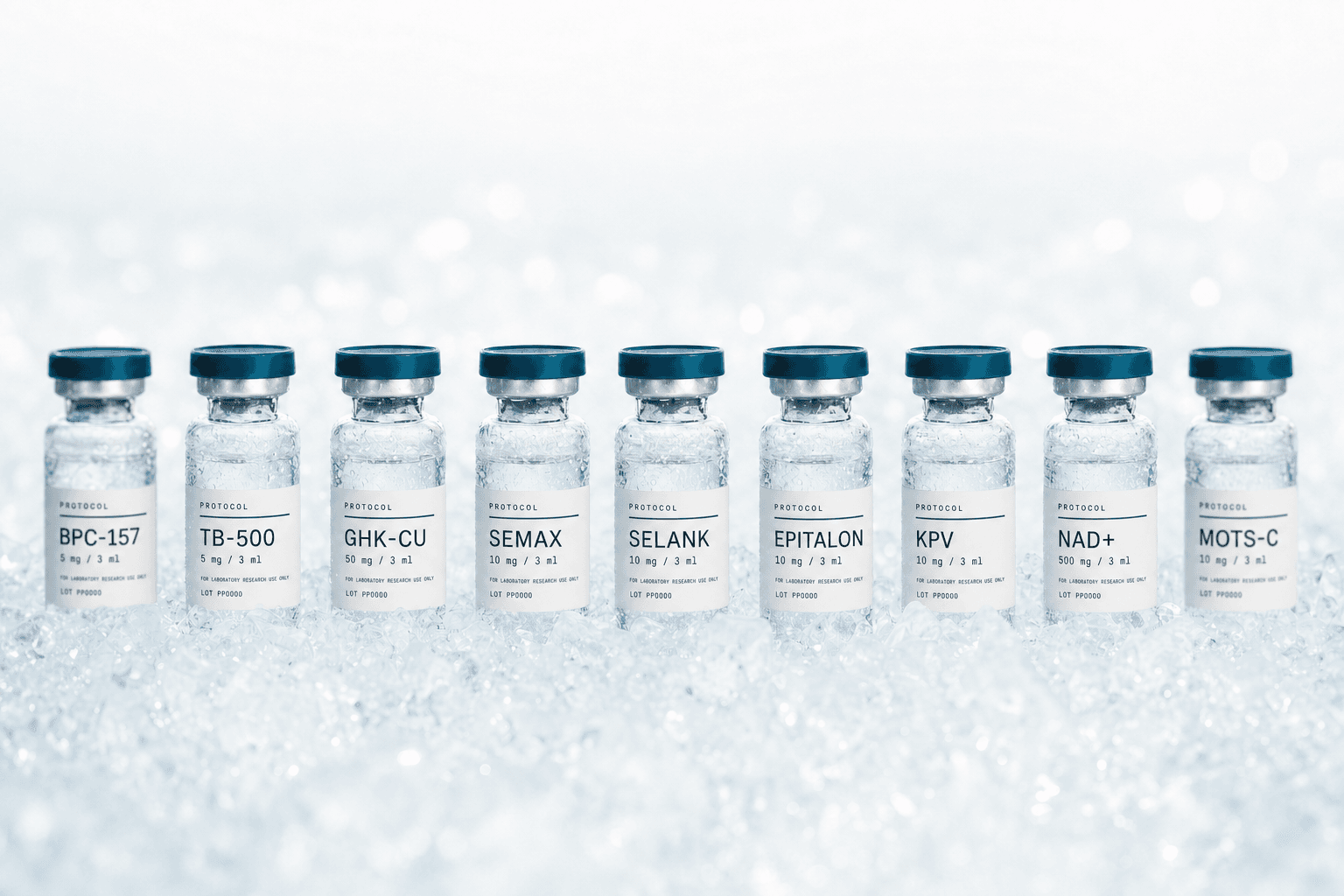
Epitalon
Cellular Longevity and Immune Signalling
£25.00per vial
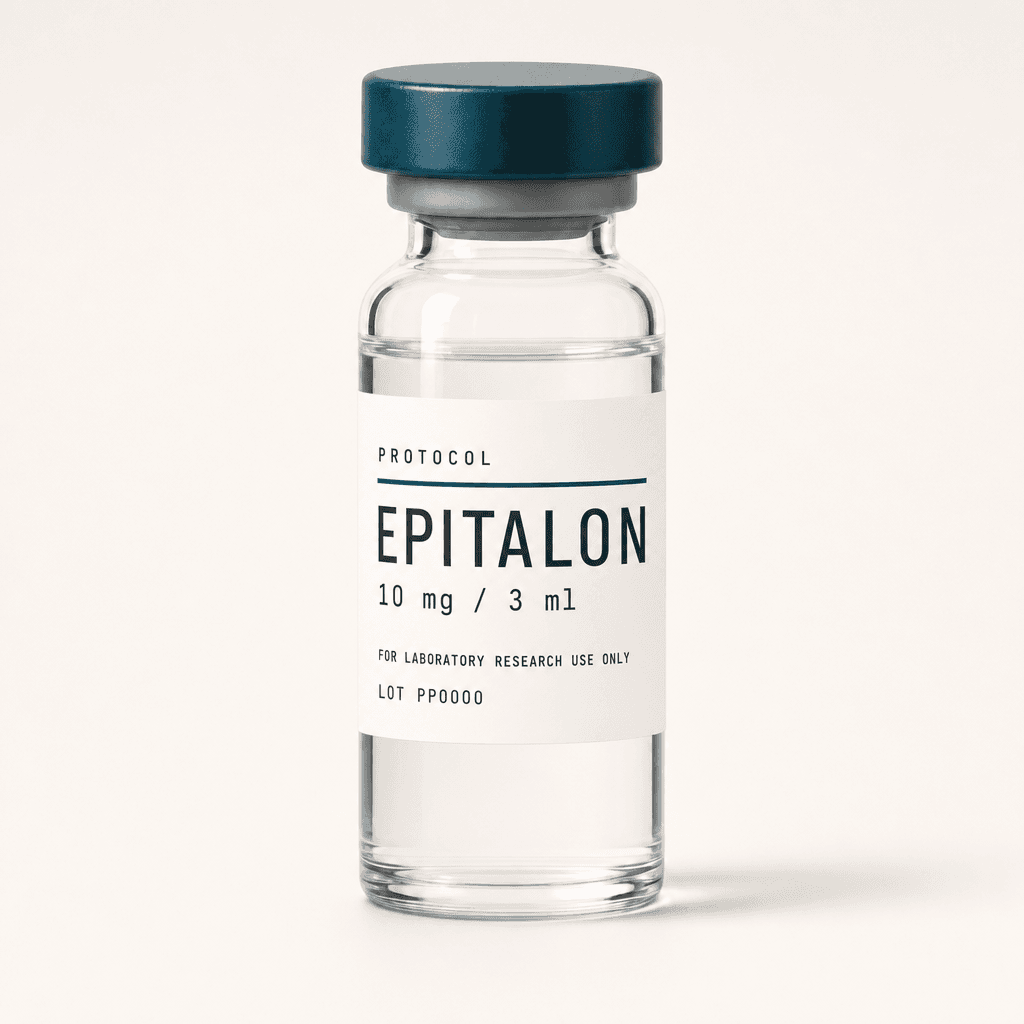
Epitalon is a synthetic tetrapeptide, Ala-Glu-Asp-Gly, isolated as the active fragment of the pineal extract epithalamin. Laboratory work examines it in telomerase expression assays, telomere length measurement, and pineal-axis and circadian gene-expression models, where its four-residue length is what makes a defined single sequence available in place of the parent mixture.
For laboratory research only. Not for human consumption. No medical claims. This product is not intended to diagnose, treat, cure, or prevent any disease.
This vial is sealed for the protection of health and hygiene. Under regulation 28(1)(e) of the Consumer Contracts (Information, Cancellation and Additional Charges) Regulations 2013, the 14-day right to cancel is lost for this item once that seal is broken. While the seal is intact the right applies in full.
Epitalon cannot be listed to research users in Australia, Canada, Japan, Mexico, New Zealand, Norway, Russian Federation, Saudi Arabia, Singapore, South Korea, Switzerland, United Arab Emirates. Verify local eligibility before ordering.
Listed
- Molecular weight
- 390.4 g/mol
- Sequence
- AEDG
- Presentation
- Pre-mixed liquid, 3ml vial
For laboratory research only. Not for human consumption. No medical claims.
- UK DISPATCH
- TRACKED SHIPPING
- COA PER BATCH
- SECURE PAYMENT
§01Compound Profile
Every batch is independently analysed by HPLC and mass spectrometry before it is listed, and the Certificate of Analysis for that batch is published in full, including the measured purity figure for that batch.
HPLC
Purity by chromatography
ANALYSED
MASS SPECTROMETRY
Identity confirmation
ANALYSED
PUBLIC COA
Every batch number resolves to its Certificate of Analysis
DOCUMENTED
§02The Science
Published constants and presentation for Epitalon, as catalogued.
Every figure in this list is a published constant or a presentation fact. None of it is an analytical result: the measured figures live on the Certificate of Analysis for the batch.
- Molecular weight
- 390.4 g/mol
- Sequence
- AEDG
- Presentation
- Pre-mixed liquid, 3ml vial
- Batch reference
- EP5614
Molecular weight source: PubChem CID 219042 (epitalon).
§03Certificate of Analysis
Every batch is independently analysed by HPLC and mass spectrometry before it is listed, and the Certificate of Analysis for that batch is published in full, including the measured purity figure for that batch.
| PARAMETER | METHOD | RESULT |
|---|---|---|
| Purity | HPLC | 97.7% |
| Identity | Mass spectrometry | Confirmed |
EP5614 · 2026-07-14
§04Compound details
Epitalon, also referenced in the literature as epithalon or the AEDG peptide, is a synthetic tetrapeptide of alanine, glutamic acid, aspartic acid and glycine. It was derived from epithalamin, a pineal gland extract characterised in Soviet and Russian gerontology work from the 1970s onward, and the four-residue sequence is the isolated fragment that preparation was attributed to. Its brevity is the research property: at under 400 daltons it can be synthesised to a single defined sequence and holds that sequence across an assay window, which the parent extract, a mixture of many peptides, cannot.
The mechanism examined most often is transcriptional. Published work reports induction of the telomerase reverse transcriptase subunit, TERT, in somatic cell cultures, with telomere length and population doubling as the measured endpoints. A second line of investigation treats the peptide as a gene-expression modulator on its own terms, using it in chromatin-accessibility and promoter-binding studies where the question is whether a tetrapeptide associates with DNA directly rather than through a receptor. Circadian and pineal-axis models form the third context, examining melatonin synthesis enzymes and clock gene expression in pinealocyte preparations.
Much of the foundational literature is Russian-language and predates independent replication, a limitation that literature states of itself, and it is one reason Epitalon continues to attract laboratory investigation rather than settling into consensus. Epitalon is catalogued here as a reference compound for laboratory research. The findings above are drawn from cell-culture and animal models. No therapeutic, diagnostic, or clinical conclusion is drawn from them, and none should be inferred.
Epitalon is listed as a pre-mixed liquid in a sealed 3ml vial, at 10mg and 50mg. It is not a lyophilised presentation and there is no reconstitution step for the research user to perform.
Every batch is independently analysed before it is listed. Purity is measured by high-performance liquid chromatography. Identity is confirmed by mass spectrometry, which for a four-residue sequence carries most of the identification: a tetrapeptide gives chromatography little to resolve against its own truncation products. Those are the two analytical methods used, and no other method is claimed.
Each vial carries a batch number. That batch number resolves to the public Certificate of Analysis for that batch, which reports the compound, the lot reference, the HPLC result, the mass-spectrometry result, the analysis date, and the laboratory that ran it. The document is published before the batch enters the catalogue, not issued on request afterwards.
Research Use Only
Epitalon is catalogued strictly for in-vitro laboratory research. It is not for human consumption, veterinary use, or therapeutic, diagnostic or clinical application. It is not supplied as a medicinal product and it is not licensed by the MHRA.
Not a Medical Product
None of the compounds listed on this site are medicinal products, nor should they be marketed, described or used as such. No medical claims are made about Epitalon. Nothing on this page is medical, veterinary or scientific advice, and no guidance on preparation, administration or quantity is provided or will be provided on request.
Compliance and Responsibility
The research user is responsible for ensuring compliance with all laws and regulations governing the receipt, handling, storage, use and disposal of research chemicals in their jurisdiction, and for applying appropriate control measures under the Control of Substances Hazardous to Health Regulations 2002 or the equivalent local regime.
Analytical Scope
Analytical results published for Epitalon relate solely to the batch identified on the Certificate of Analysis. Two methods are used: high-performance liquid chromatography and mass spectrometry. No other analysis is performed or implied. Results for one batch do not warrant any other batch.
Jurisdiction Notice
Epitalon cannot be listed to research users in the following jurisdictions: Australia, Canada, Japan, Mexico, New Zealand, Norway, Russian Federation, Saudi Arabia, Singapore, South Korea, Switzerland, United Arab Emirates. It is the research user's responsibility to verify local eligibility before placing an order. Where an order is placed for a jurisdiction in which the compound cannot be listed, the order will be cancelled and refunded in full.
Research Context
Epitalon, also referenced in the literature as epithalon or the AEDG peptide, is a synthetic tetrapeptide of alanine, glutamic acid, aspartic acid and glycine. It was derived from epithalamin, a pineal gland extract characterised in Soviet and Russian gerontology work from the 1970s onward, and the four-residue sequence is the isolated fragment that preparation was attributed to. Its brevity is the research property: at under 400 daltons it can be synthesised to a single defined sequence and holds that sequence across an assay window, which the parent extract, a mixture of many peptides, cannot.
The mechanism examined most often is transcriptional. Published work reports induction of the telomerase reverse transcriptase subunit, TERT, in somatic cell cultures, with telomere length and population doubling as the measured endpoints. A second line of investigation treats the peptide as a gene-expression modulator on its own terms, using it in chromatin-accessibility and promoter-binding studies where the question is whether a tetrapeptide associates with DNA directly rather than through a receptor. Circadian and pineal-axis models form the third context, examining melatonin synthesis enzymes and clock gene expression in pinealocyte preparations.
Much of the foundational literature is Russian-language and predates independent replication, a limitation that literature states of itself, and it is one reason Epitalon continues to attract laboratory investigation rather than settling into consensus. Epitalon is catalogued here as a reference compound for laboratory research. The findings above are drawn from cell-culture and animal models. No therapeutic, diagnostic, or clinical conclusion is drawn from them, and none should be inferred.
Analysis and Documentation
Epitalon is listed as a pre-mixed liquid in a sealed 3ml vial, at 10mg and 50mg. It is not a lyophilised presentation and there is no reconstitution step for the research user to perform.
Every batch is independently analysed before it is listed. Purity is measured by high-performance liquid chromatography. Identity is confirmed by mass spectrometry, which for a four-residue sequence carries most of the identification: a tetrapeptide gives chromatography little to resolve against its own truncation products. Those are the two analytical methods used, and no other method is claimed.
Each vial carries a batch number. That batch number resolves to the public Certificate of Analysis for that batch, which reports the compound, the lot reference, the HPLC result, the mass-spectrometry result, the analysis date, and the laboratory that ran it. The document is published before the batch enters the catalogue, not issued on request afterwards.
Compliance Notice
Research Use Only
Epitalon is catalogued strictly for in-vitro laboratory research. It is not for human consumption, veterinary use, or therapeutic, diagnostic or clinical application. It is not supplied as a medicinal product and it is not licensed by the MHRA.
Not a Medical Product
None of the compounds listed on this site are medicinal products, nor should they be marketed, described or used as such. No medical claims are made about Epitalon. Nothing on this page is medical, veterinary or scientific advice, and no guidance on preparation, administration or quantity is provided or will be provided on request.
Compliance and Responsibility
The research user is responsible for ensuring compliance with all laws and regulations governing the receipt, handling, storage, use and disposal of research chemicals in their jurisdiction, and for applying appropriate control measures under the Control of Substances Hazardous to Health Regulations 2002 or the equivalent local regime.
Analytical Scope
Analytical results published for Epitalon relate solely to the batch identified on the Certificate of Analysis. Two methods are used: high-performance liquid chromatography and mass spectrometry. No other analysis is performed or implied. Results for one batch do not warrant any other batch.
Jurisdiction Notice
Epitalon cannot be listed to research users in the following jurisdictions: Australia, Canada, Japan, Mexico, New Zealand, Norway, Russian Federation, Saudi Arabia, Singapore, South Korea, Switzerland, United Arab Emirates. It is the research user's responsibility to verify local eligibility before placing an order. Where an order is placed for a jurisdiction in which the compound cannot be listed, the order will be cancelled and refunded in full.
§05Related compounds
§06Questions
No. Epitalon is catalogued strictly for in-vitro laboratory research. It is not for human or veterinary consumption and no medical claims are made.
Telomerase reverse transcriptase expression, telomere length measurement, and circadian and pineal-axis gene expression in cell-culture and animal models. Findings are preclinical.
A synthetic tetrapeptide of alanine, glutamic acid, aspartic acid and glycine, referenced in the literature as the AEDG peptide. It is the isolated fragment of the pineal extract epithalamin.
Yes. Epitalon, epithalon and the AEDG peptide are three names for the same tetrapeptide listed on this page.
Pre-mixed liquid in a sealed 3ml vial, at 10mg and 50mg. It is not a lyophilised powder and needs no preparation before laboratory use.
Every batch has a document.
The Certificate of Analysis for a batch is published when that batch is released. Your batch number resolves to the report.
For laboratory research only. Not for human consumption. No medical claims.