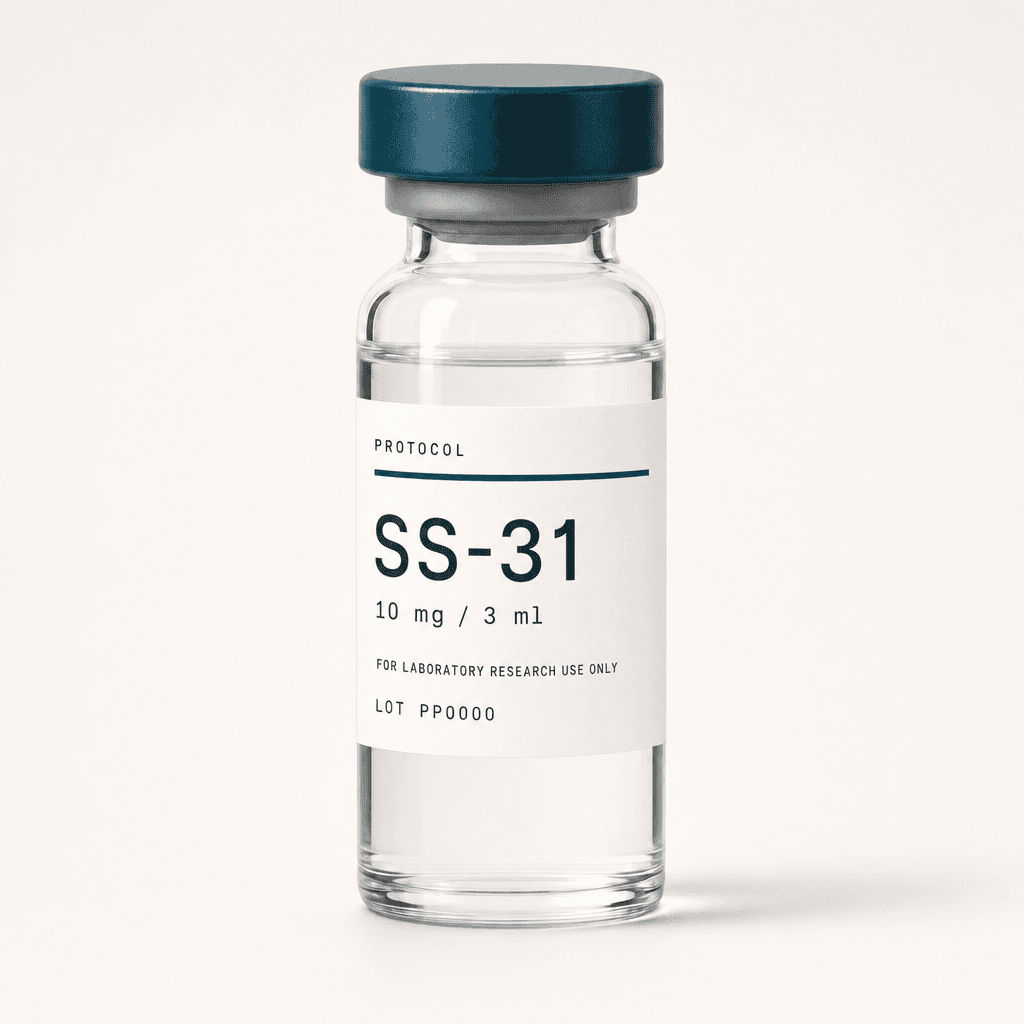
SS-31
Metabolic and Mitochondrial
£25.00per vial
SS-31 is a synthetic tetrapeptide of the Szeto-Schiller series, referenced in the literature as elamipretide. Its alternating aromatic and cationic residues drive accumulation in the inner mitochondrial membrane independently of membrane potential, and it is studied for association with cardiolipin, electron transport chain organisation, and mitochondrial redox handling.
For laboratory research only. Not for human consumption. No medical claims. This product is not intended to diagnose, treat, cure, or prevent any disease.
This vial is sealed for the protection of health and hygiene. Under regulation 28(1)(e) of the Consumer Contracts (Information, Cancellation and Additional Charges) Regulations 2013, the 14-day right to cancel is lost for this item once that seal is broken. While the seal is intact the right applies in full.
SS-31 cannot be listed to research users in Australia, Canada, Japan, Mexico, New Zealand, Norway, Russian Federation, Saudi Arabia, Singapore, South Korea, Switzerland, United Arab Emirates. Verify local eligibility before ordering.
Listed
- Molecular weight
- 639.8 g/mol
- Sequence
- D-Arg-Dmt-Lys-Phe-NH2
- Presentation
- Pre-mixed liquid, 3ml vial
For laboratory research only. Not for human consumption. No medical claims.
- UK DISPATCH
- TRACKED SHIPPING
- COA PER BATCH
- SECURE PAYMENT
§01Compound Profile
Every batch is independently analysed by HPLC and mass spectrometry before it is listed, and the Certificate of Analysis for that batch is published in full, including the measured purity figure for that batch.
HPLC
Purity by chromatography
ANALYSED
MASS SPECTROMETRY
Identity confirmation
ANALYSED
PUBLIC COA
Every batch number resolves to its Certificate of Analysis
DOCUMENTED
§02The Science
Published constants and presentation for SS-31, as catalogued.
Every figure in this list is a published constant or a presentation fact. None of it is an analytical result: the measured figures live on the Certificate of Analysis for the batch.
- Molecular weight
- 639.8 g/mol
- Sequence
- D-Arg-Dmt-Lys-Phe-NH2
- Presentation
- Pre-mixed liquid, 3ml vial
- Batch reference
- SS5608
Molecular weight source: PubChem CID 11764719 (elamipretide).
§03Certificate of Analysis
Every batch is independently analysed by HPLC and mass spectrometry before it is listed, and the Certificate of Analysis for that batch is published in full, including the measured purity figure for that batch.
| PARAMETER | METHOD | RESULT |
|---|---|---|
| Purity | HPLC | 99% |
| Identity | Mass spectrometry | Confirmed |
SS5608 · 2026-06-30
§04Compound details
SS-31 is a four-residue peptide of the Szeto-Schiller class, composed of D-arginine, 2,6-dimethyltyrosine, lysine and phenylalanine, carrying a C-terminal amide. The alternating cationic and aromatic residues are the design feature: the motif partitions the molecule into the inner mitochondrial membrane and holds it there, and it does so without depending on the membrane potential. That distinguishes it from potential-driven mitochondrial probes such as the triphenylphosphonium conjugates, and it is the reason SS-31 is used in study designs where the potential itself is the variable under measurement.
The characterised binding partner is cardiolipin, the four-chain phospholipid effectively confined to the inner mitochondrial membrane. Published work describes association with cardiolipin rather than catalysis, with the measured consequences being cristae organisation, the stability of respiratory supercomplexes, and the interaction between cardiolipin and cytochrome c that governs whether that protein acts as an electron carrier or as a peroxidase. Endpoints in this work are oxygen consumption rate, ATP synthesis rate, membrane potential, and reactive-oxygen-species production.
Preclinical models span mitochondrial myopathy, cardiac and renal ischaemia-reperfusion, and age-related decline in skeletal muscle bioenergetics. The compound also appears as a pharmacological tool for separating cardiolipin-dependent effects from other mitochondrial interventions in the same preparation. SS-31 is catalogued here as a reference compound for laboratory research. No therapeutic, diagnostic, or clinical conclusion is drawn from any study referenced above, and none should be inferred.
SS-31 is listed as a pre-mixed liquid in a sealed 3ml vial, at 10mg and 50mg. It is not a lyophilised presentation and there is no reconstitution step for the research user to perform.
Every batch is independently analysed before it is listed. Purity is measured by high-performance liquid chromatography. Identity is confirmed by mass spectrometry against the expected mass, which for this sequence also confirms the 2,6-dimethyltyrosine residue rather than unmethylated tyrosine, a difference of 28 daltons. Those are the two analytical methods used, and no other method is claimed.
Each vial carries a batch number that resolves to the public Certificate of Analysis for that batch, reporting the compound, the lot reference, the HPLC result, the mass-spectrometry result, the analysis date, and the laboratory that ran it. The document is published before the batch enters the catalogue.
Research Use Only
SS-31 is catalogued strictly for in-vitro laboratory research. It is not for human consumption, veterinary use, or therapeutic, diagnostic or clinical application. It is not supplied as a medicinal product and it is not licensed by the MHRA.
Not a Medical Product
None of the compounds listed on this site are medicinal products, nor should they be marketed, described or used as such. No medical claims are made about SS-31. Nothing on this page is medical, veterinary or scientific advice, and no guidance on preparation, administration or quantity is provided or will be provided on request.
Compliance and Responsibility
The research user is responsible for ensuring compliance with all laws and regulations governing the receipt, handling, storage, use and disposal of research chemicals in their jurisdiction, and for applying appropriate control measures under the Control of Substances Hazardous to Health Regulations 2002 or the equivalent local regime.
Analytical Scope
Analytical results published for SS-31 relate solely to the batch identified on the Certificate of Analysis. Two methods are used: high-performance liquid chromatography and mass spectrometry. No other analysis is performed or implied. Results for one batch do not warrant any other batch.
Jurisdiction Notice
SS-31 cannot be listed to research users in the following jurisdictions: Australia, Canada, Japan, Mexico, New Zealand, Norway, Russian Federation, Saudi Arabia, Singapore, South Korea, Switzerland, United Arab Emirates. It is the research user's responsibility to verify local eligibility before placing an order. Where an order is placed for a jurisdiction in which the compound cannot be listed, the order will be cancelled and refunded in full.
Research Context
SS-31 is a four-residue peptide of the Szeto-Schiller class, composed of D-arginine, 2,6-dimethyltyrosine, lysine and phenylalanine, carrying a C-terminal amide. The alternating cationic and aromatic residues are the design feature: the motif partitions the molecule into the inner mitochondrial membrane and holds it there, and it does so without depending on the membrane potential. That distinguishes it from potential-driven mitochondrial probes such as the triphenylphosphonium conjugates, and it is the reason SS-31 is used in study designs where the potential itself is the variable under measurement.
The characterised binding partner is cardiolipin, the four-chain phospholipid effectively confined to the inner mitochondrial membrane. Published work describes association with cardiolipin rather than catalysis, with the measured consequences being cristae organisation, the stability of respiratory supercomplexes, and the interaction between cardiolipin and cytochrome c that governs whether that protein acts as an electron carrier or as a peroxidase. Endpoints in this work are oxygen consumption rate, ATP synthesis rate, membrane potential, and reactive-oxygen-species production.
Preclinical models span mitochondrial myopathy, cardiac and renal ischaemia-reperfusion, and age-related decline in skeletal muscle bioenergetics. The compound also appears as a pharmacological tool for separating cardiolipin-dependent effects from other mitochondrial interventions in the same preparation. SS-31 is catalogued here as a reference compound for laboratory research. No therapeutic, diagnostic, or clinical conclusion is drawn from any study referenced above, and none should be inferred.
Analysis and Documentation
SS-31 is listed as a pre-mixed liquid in a sealed 3ml vial, at 10mg and 50mg. It is not a lyophilised presentation and there is no reconstitution step for the research user to perform.
Every batch is independently analysed before it is listed. Purity is measured by high-performance liquid chromatography. Identity is confirmed by mass spectrometry against the expected mass, which for this sequence also confirms the 2,6-dimethyltyrosine residue rather than unmethylated tyrosine, a difference of 28 daltons. Those are the two analytical methods used, and no other method is claimed.
Each vial carries a batch number that resolves to the public Certificate of Analysis for that batch, reporting the compound, the lot reference, the HPLC result, the mass-spectrometry result, the analysis date, and the laboratory that ran it. The document is published before the batch enters the catalogue.
Compliance Notice
Research Use Only
SS-31 is catalogued strictly for in-vitro laboratory research. It is not for human consumption, veterinary use, or therapeutic, diagnostic or clinical application. It is not supplied as a medicinal product and it is not licensed by the MHRA.
Not a Medical Product
None of the compounds listed on this site are medicinal products, nor should they be marketed, described or used as such. No medical claims are made about SS-31. Nothing on this page is medical, veterinary or scientific advice, and no guidance on preparation, administration or quantity is provided or will be provided on request.
Compliance and Responsibility
The research user is responsible for ensuring compliance with all laws and regulations governing the receipt, handling, storage, use and disposal of research chemicals in their jurisdiction, and for applying appropriate control measures under the Control of Substances Hazardous to Health Regulations 2002 or the equivalent local regime.
Analytical Scope
Analytical results published for SS-31 relate solely to the batch identified on the Certificate of Analysis. Two methods are used: high-performance liquid chromatography and mass spectrometry. No other analysis is performed or implied. Results for one batch do not warrant any other batch.
Jurisdiction Notice
SS-31 cannot be listed to research users in the following jurisdictions: Australia, Canada, Japan, Mexico, New Zealand, Norway, Russian Federation, Saudi Arabia, Singapore, South Korea, Switzerland, United Arab Emirates. It is the research user's responsibility to verify local eligibility before placing an order. Where an order is placed for a jurisdiction in which the compound cannot be listed, the order will be cancelled and refunded in full.
§05Related compounds
§06Questions
No. SS-31 is catalogued strictly for in-vitro laboratory research. It is not for human or veterinary consumption and no medical claims are made.
Association with cardiolipin in the inner mitochondrial membrane, cristae and respiratory supercomplex organisation, and mitochondrial redox handling. Findings are preclinical.
Through its alternating aromatic and cationic residue motif, which partitions into the membrane without depending on the membrane potential. That is what separates it from potential-driven mitochondrial probes.
Yes. SS-31, elamipretide and MTP-131 are three names for the same tetrapeptide listed on this page.
Pre-mixed liquid in a sealed 3ml vial, at 10mg and 50mg. It is not a lyophilised powder and needs no preparation before laboratory use.
Every batch has a document.
The Certificate of Analysis for a batch is published when that batch is released. Your batch number resolves to the report.
For laboratory research only. Not for human consumption. No medical claims.